Tuesday, 5 January 2016

UNIT 28: STORYTELLING AS PERFORMANCE Task 1: Preliminary Research (Myth/Legend) 5/01/16


What a makes something a Myth or a Legend?

About Myths and Legends…

What are myths, legends and folktales?

Human beings have been telling stories since they first learned to speak. And even before we could speak, we managed to tell stories by drawing and painting pictures on the walls of the caves we lived in. Once upon a time, long, long ago, before even your teachers were born, there lived some really great storytellers. Their stories have been passed down, retold, translated, adapted and, more recently, written down, because everyone loves a good story! Do some of your favourites include haunting and murder, treasure and battle, wicked deeds and heroic actions? These stories probably include legends, myths and folktales.

What are legends?

A legend is usually based on a true event in the past. 
However, the story may have changed over time to take on some special 'mythical' features.
Legends usually have a real hero at the centre of the story and they are often set in fantastic places. The story will have been passed on from person to person, sometimes over a very long period of time. The fact that so many people have taken the trouble to keep the story alive, usually tells you that it has some very important meaning for the culture or region in which the story was first told.

What are myths?

A myth is not quite the same as a legend. Sometimes a myth is loosely based on a real event but, more often than not, it is a story that has been created to teach people about something very important and meaningful.
Myths are often used to explain the world and major events, which, at the time, people were not able to understand - earthquakes, floods, volcanic eruptions, the rising and setting of the sun, illness and death. Many of the myths relating to such events have survived for a very long time, sometimes for thousands of years, as it is only in recent times that we have begun to understand why some of these things happen.

What are folktales?

Folktales are usually stories that have been passed down from generation to generation in spoken form. Often we do not know who the original author was and it is possible that some stories might have been concocted around a campfire by a whole group of people. It is quite normal to discover that there are many versions of the tale, some very similar but others may have only one or two characters in common and take place in totally different settings.
Many of the stories we call 'fairy tales' are really folktales - Sleeping Beauty, Hansel and Gretel, The Three Little Pigs. These stories were probably inspired by events which happened so long ago that we no longer have a record of what those events were.

What is the difference between legends, myths and folktales?

It is very hard to list the differences between myths, legends and folktales. In fact, it is often easier to say what they have in common than to say what makes them different from one another.

The main difference is probably to do with how much the story is based on a true event.

What we call legends are generally stories, which have an actual historical event or person as their starting point. Myths are sometimes based on legends but are altered in a way that makes them useful to teach people how to behave or to give an explanation of the world around.

Folktales may also have started their life by being based on an event, but they are changed almost every time they are told and, as time passes, the story loses its connection to reality and the message or moral of the story becomes much more important.


It's not really so important to spot the difference between the three types. Just enjoy the stories for themselves and see if you can tell what the purpose of the story was originally. Why might the story have been told in the first place? Are you able to tell how it has changed over time?


Link

Auditioning/Casting Call preparation:

Wicked


  •  read and listen to the material
  • story
  • character (role you want)
  • genre
  • author (play write)
  • composer
  • the world of the play

Ordinary
  • magic
  • talking animals
  • wizard
  • flying monkeys
  • city of emerald
  • armed guards
  • singing/dancing
  • midgets
  • talking tinman

Extra Ordinary

green people
flying houses

a) find a monologue that agrees to the song.
b) find a monologue that agrees to the tone, style and sound.

Aural Quality = how it sounds fitting in one universe.

Picking a character like Glinda, she described as...

Sparkly, Confident, Pink, Blonde, Juvenile, Perfect and Giggly.

Therefore I could compare this musical to 'LEGALLY BLONDE'

as the character Elle Woods has some similar aspects of Glinda's character too.

3. Remind the panel of the world of the play and your character, in all aspects starting with...

  • Dress
  • Demeanor
  • Tone
When you do get a call back do not forget to wear the same outfit you wore before!

Key to a successful actor:
BE FRIENDLY, POLITE & PROFFESIONAL

Saturday, 2 January 2016

Overview of my Vocal class...

The reason I started with the laying down exercise as it eases your mind and gets your whole body relaxed before going through with the warm up.
Low humming noise helps you as an actor to focus on your own self and the sound you are producing.

I done the neck rolls second as it massively helps to warm up your throat muscles which is the most important part to focus and warm up upon as the voice box allows us to speak. 

The tongue twisters warm up helps me while I am nervous before going on stage, as I tend to have difficulties with pronunciations of words and words starting with the same letters continuously.

The lion/mouse face exercise enables the face to be fully relaxed so your able to perform, and being comfortable with producing any facial expression and showing emotion when you need to without any tension within your face.

The PTKT and BDBD pronunciation is key as most East Londoners is something we struggle on, as we find it hard to pronounce each word rights as we tend to silent some letters in a word which I always get told of upon.

Warming up exercise for Actors: Voice Class Presentation

Warming up exercise for Actors

The Routine:

1. Lie down
on your back in a comfortable position. LOW HUMMING NOISE, roll your body to one side and get up to keep your breathing INTACT. (Repeat 5 Times)

2. Neck rolls,
rotating your head SLOWLY - clockwise and anticlockwise, add on with shoulder rolls. Helps to warm up your throat muscles.

3. Facial Massage,
massage your whole face, by drawing circles with the tip of your fingers to enable a relaxing of your face. (Repeat 6 Times)

4. Jump up and down, shake your hands and feet for the CIRCULATION and loosening up of the muscles.

5. I call it the LION/MOUSE FACE technique, stretch your mouth wide open, demonstrating a roar effect. Mouse scrunching of your face and mouth. Move your tongue around your gum! Pretending your eating a sweet and enjoying it.

Ruth: " It is essential  to warm up as an actor before a performance, as it allows the performer to be more relaxed and ready."

Understanding of voice Production

Understanding of voice Production

Power Source

Your breathe has several factors:

Lungs, Diaphragm expansion and Abdominal support.

The reason it is called power source is because that is where you collect all your sources which will help you to breathe correctly.

Vibratory Source

Vibration of your vocal folds causes vibration in the air, which your lungs have just generated and also what your abdominal muscles have pushed.

The EPITHELIUM is the outermost layer of the vocal folds. It is the thin and moist which resembles to the lining of the inside of the cheek.

The next layer is the SLP, the vibrations of the layer are what makes sound and loss of the SLP which results in the scarring and hoarseness.

The final layer is the vocal ligament, the tension in this structure helps determine the speed of the vibration and as well as the PITCH of the sound.


Resonators

The resonators gives all the richness and tone that makes the voice musical and it also gives individual qualities to the character.

The nasal passage, the throat and the mouth are air chambers which shapes the sound. This is why when you have a cold you loose resonance which leads to your notes being flat. 

Personal Contribution

                                    Thursday 10th December 2015
Ruth Martino                                
S1400309

Personal Contribution – Ruth Martino

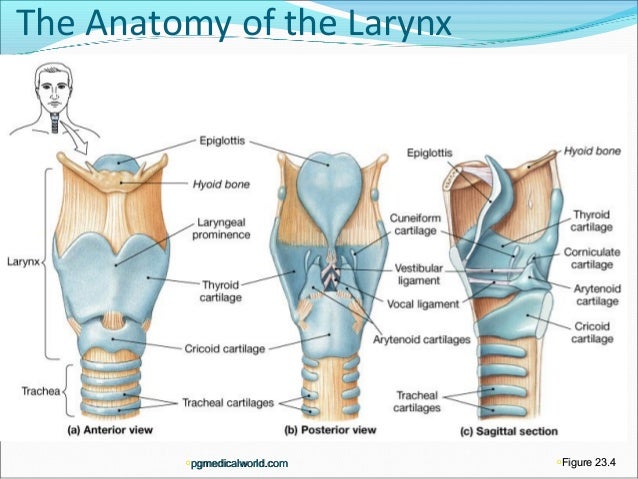
My contribution to the presentation was first the focus upon the understanding of the voice production which I first started searching images of the Anatomy of the Larynx has it will enable me to have a close look into each parts inside the larynx and what they are called. Some of the names I paid most attention in was the Trachea is a larger membrane tube which extends from the larynx to the bronchial tubes which then enables air to get through the lungs. I also learned about the Epiglottis which is referred as a flap behind the tongue which is very essential as it gets depressed during the swallowing process to cover the opening of the lung as know as the windpipe. Researching about the Larynx has taught me that it could be compared to the body of the throat as the word anatomy means the bodily structure of the humans, learning as well that the larynx is where the vocal chords are located has helped me to understand the significance of the larynx because that is where the sound comes from while wanting to project as an actor.

Now looking into the vocal chords, I weren’t aware that we had two of them on opposite sides that’s why they describe it as ‘twin folding’. Having a picture displaying the vocal chords was very beneficial for me especially as I got to see the visual side of how everything inside the mouth is laid out. Vocal Chords was something I really wanted to get clear on mainly as a performer teachers tend to always touch upon it; however I never were clear about how it functions and the purpose of it. Both vocal chords vibrate which then regulates the flow of the air being released from the lungs during phonation. The vocal chords is the main source or sound creation which as an actor immediately alerts you that, that is one of the soft tissues that has to be looked after with great care, that is when my research of how to maintain a healthy voice comes helpful.

I searched on Google (American Academy) on how to keep a healthy voice, it has given me that drinking loads of water is the key way of keeping your voice in shape. Drinking water three times a day to help keep your body well and hydrated. On the website they’ve advised to definitely avoid alcohol and caffeine, I wasn’t so sure to why we were told to stay away from that, so therefore I searched it up (voicecouncil.com) I gathered the information that the vocal folds require moisture to work efficiently although caffeine comes in the form of a liquid, it acts as a drying agent. Adding on with facts of caffeine tends to pull water out of your system and causes the vocal folds of needing lubrication. So for that reason a dry vocal chord tends to tighten which hinders the vocal range and within the endurance. Eating fruits is required as it contains a large amount of water in it, I was so not aware that ‘bell peppers’ contained water in it, so for that I was really shocked about that suggestion.

My reaction to the process of the group presentation was quite disappointing as I felt some people didn’t put as much effort in researching information, people in my group tend to choose the easy path like for e.g. choosing rather easy topics to research on and doing less work on it. I was frustrated at times as I felt I was the only one who cared more and was going the extra mile to produce a effortless presentation. Someone in my group suggested they’d only wanted to write their own notes down and read from it, but my respond to it was that the presentation is targeted towards students in year 11 who are way younger than us, at that age seeing imagery in a presentation kept me engaged at all times and allowed me to picture a visual image in my mind of what the presenter could be talking about. To be honest the members of my group doing work last minuet and not being sure what they’re doing caused me to panic and doubt myself too as I had a gut feeling that the presentation would look unprepared.

My reaction to the presentation changed as we got the chance to look back on the video, adding more vibrant colors into the power point side made it look as exciting. I know for sure learning about voice production, vocal techniques and how to keep a healthy voice could be so boring. Isabelle being in charge of presenting the voice production, Deneille being responsible of presenting the background information of what vocal techniques benefit to us actors and me being the last to talk about how to maintain a healthy voice, has allowed everyone in my group to not take the lion’s chair resulting to everyone putting in an input within the presentation. Although as a viewer you could identify who was put more effort than whom, as a team I felt we done our best and allowed our setbacks to be our comebacks. Working with Deneille and Isabelle was a huge challenge for me as I’ve never worked with them before leaving me with being a bit reserved at first. From previous knowledge knowing one member hardly comes in and the other having a negative attitude also with me being the one who gives up half way, I knew the group work would be something. Well I am proud of what we produced as a team and I could say everything that all the negative thoughts were worth it at the end because it made us want to do more work into grafting our presentation better.

Thursday, 19 November 2015

Unit 17: Developing Voice for the Actor

Understanding of Voice Production:


Larynx
Definition: The hollow muscular organ forming an air passage to the lungs and holding the vocal cords in humans and other mammals; the voice box.
Highly specialised structure atop the windpipe responsible for sound production, air passage during breathing and protecting the airway during swallowing.


Vocal Folds (Vocal Chords)-  
Definition: The vocal folds are composed of twin foldings or mucous membrane stretched horizontally, from back to front, across the larynx. They vibrate, modulating the flow of air being expelled from the lungs during phonation.
"Fold-like" Soft tissues that is the main vibratory of the voice box; comprised of a cover (epithelium and superficial lamina propria), vocal ligament (intermediate and deep laminae propria), and body (thyroarytenoid muscle).


Glottis (Rima Glottides)- 

Definition:The part of the larynx consisting of the vocal cords and the slit-like opening them. It affects voice modulation through expansion or contraction
Opening between the two vocal folds; the glottis opens during the breathing and closes during swallowing and the sound production.


Vocal Technique in Performance for Actors
:

As an actor you can practise Diction by reciting tongue twisters such as...
These first two are my overall favorites.
They are particularly good for achieving
a crisp, frontal placement of consonants
The lips, the teeth, the tip of the tongue,
the tip of the tongue, the teeth, the lips.


or work on your breathing by reciting scripts or poetry that sets challenges for you. For example trying to complete a whole piece without taking a breathe or allow yourself only limited breathing space through a Shakespearean acting piece, which mine is...

Constance: Thou art not holy to belie me so; 

I am not mad: this hair I tear is mine; 
My name is Constance; I was Geffrey's wife; 
Young Arthur is my son, and he is lost: 
I am not mad: I would to heaven I were! 
For then, 'tis like I should forget myself: 
O, if I could, what grief should I forget! 
Preach some philosophy to make me mad, 
And thou shalt be canonized, cardinal; 
For being not mad but sensible of grief, 
My reasonable part produces reason 
How I may be deliver'd of these woes, 
And teaches me to kill or hang myself: 
If I were mad, I should forget my son, 
Or madly think a babe of clouts were he: 
I am not mad; too well, too well I feel 
The different plague of each calamity.


An actor needs to be able to expand their voice, as well as remaining clear and audible when whispering or performing at the lower levels of sound. Being able to learn how to appear to be speaking very quietly while filling the space with your voice requires great vocal techniques and practice. Cicely Berry has an amazing book on actors for vocal techniques.


The importance of actors on stage, in order to become familiar with vocal techniques you need to be able to work with technology as well such as being able to use microphones correctly because it is a skill that every performer should have, whether you are a Voice Acting or Performing on set. You need to be able to find the 'sweet spot' that your voice delivers a peak performance.


Principles of helping keeping your Voice in Shape for an Actor:

DRINK WATER 3 TIMES A DAY to keep your body well and hydrated, definitely avoid alcohol and caffeine. Your vocal chords tends to vibrate very fast, so therefore having a proper water balance helps keep them lubricated. The important notes to maintaining a healthy voice is eating food which contain large amounts of water which is a excellence way to keeping hydration, snacks such as... apples, pears, watermelon, peaches, melons, grapes plums, bell peppers and applesauce.

DO NOT SMOKE, or if you do already, I would advise you to quit immediately. Smoking raises the risk of throat cancer tremendously, I read in 'One Voice by Joan Melton' inhaling smoke
(even second hand smokers) 
can irritate the vocals.

Avoid clearing your throat to often, while clearing your throat
it's like slamming your vocal chords together.
Doing this to much can injure them and make you hoarse.
Try a sip of water or swallow to quench the urge to clear, if you feel like 
you have to clear your throat to often, it will be advised to get checked by a doctor
for illnesses such as acid reflux disease or allergy and sinus conditions.

VOCAL PROJECTION/BREATHING EXERCISES CONSIDERING LUNG CAPACITY:


Warm-up

It is useful to have a general physical warm-up game before this exercise: something like Run to It is ideal.
Additionally, you may want to do some facial warm-up exercises: scrunching up then stretching out, “eeee” then “ooo”, chew an imaginary ball of toffee (that’s getting bigger), stretch the tongue out (pointed & flat) and waggle it from side to side and whistle “happy birthday”.

Short introductory exercises

Few people use their full lung capacity for breathing or speaking in day to day life – these exercises should remind the group what it feels like to do so!
If there is room, have everyone lie down on the floor on their backs. We use chest/torso muscles when we stand/sit up – but for these exercises, we want to use every possible muscle for controlled breathing!
Ask everyone to take a deep breath in – remind them that they should use their diaphragm – that their chest/stomach should go out as they fill up, not their shoulders hunch up. Hold the breath for a few seconds then let it go. Repeat.
Next, ask them to take a deep breath in again but ask them to expel it in a different way as below. Repeat each of these exercises at least a few times until you feel the group is making the most of them:
  • HA! – expel all the air out of your lungs in one “pop” by saying “ha!”. This should get louder as it’s repeated and whenever anyone is talking too quietly in the future, remember how loud they got with this!
  • Hiss it out – hiss for as long as possible, until you’re all out of air
  • Ahhh – a variation on the hiss, again held until you’re out of air. This is usually faster than the hiss.
  • Count it out – a steady count as a group for as long as people can on just one breath. Make sure the numbers are strongly projected to use a good amount of air each time.

Being aware of the voice production is significantly important as an Actor to know as it enables you to be clear and to understand how sound gets released, how it is made and where it originally comes from. Researching this does make me question my self if I use these muscles correctly while performing. Being taught in lesson the scientific background of the Anatomy of the Voice does place me in a great position of becoming confident in answering questions related to the voice of and Actor/Singer. Personally I suggest the Larynx is the most important muscular organ as it consists of the Voice Box, without this muscle no sound or air gets to be pasted through.

Vocal Technique is what I daily pay the most attention to, with this own responsibility of making you as an Actor to become a better performer. The vocal techniques such as practising diction is what I mainly struggle with, I find it extremely hard to get around words with the same first letters or similar vowels. Using the exercise of tongue twisters benefits me to a large extent as it allows me to become a lot my confident with my articulation and pronunciation while performing.